Via Beato Pellegrino, 28 - 35137 Padova | 049 827 8978
 Access the private area


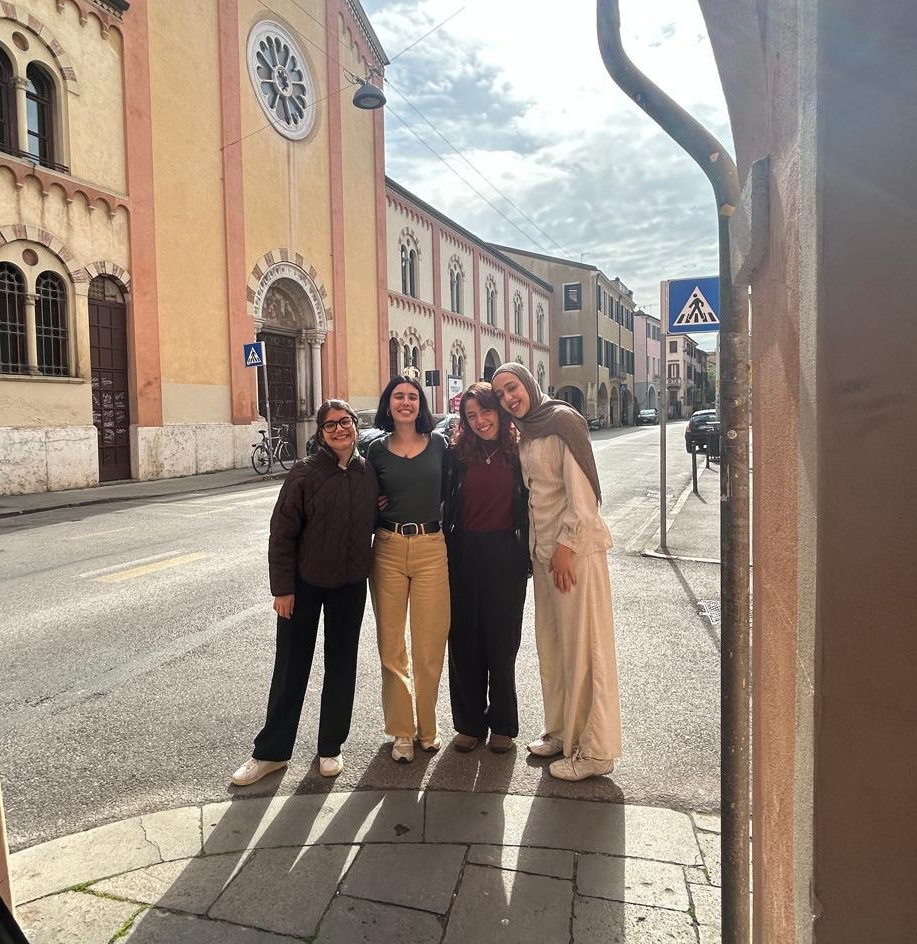
A guest post by Federica Montalto, Gabriela Bravo Vargas,Giorgia Todeschin and Veronica Bettio
As part of the activities of the PhD Programme in Pedagogical, Educational and Training Sciences (FISPPA, University of Padua), on April 15 we had the pleasure of hosting Rahaf Al-Atal, a researcher in the field of Educational Sciences, who is engaged in a research program focused on education, culture, and identity, with a particular emphasis on early childhood
Her academic background includes a Master’s degree completed in the United Kingdom in the Department of Philosophy of Management. Her work is shaped by theoretical perspectives such as process philosophy, complexity theory, and the ethics of relational knowledge. Building on these ideas, her research presents education as a living ecosystem where culture, identity, space, and emotion are closely interconnected.At the heart of her inquiry lies a question that refuses to stay quiet: how do spaces teach? And are we always able to recognize when learning is taking place? Tracing a path through Padua, Venice, Verona, Lake Garda, and Reggio Emilia, Rahaf approaches the city not as a neutral backdrop but as a living archive of layered meaning. Walking without a destination, lingering in a café where the staff remember your order, allowing oneself to be shaped by the slow rhythm of a piazza: in her perspective, none of this is time taken away from research — it is research itself.
On the theoretical level, this sensibility takes shape in an original framework research note: “Educational Space as Untested Feasibility and Compass Formation.” Drawing on Freire, Merleau-Ponty, and Foucault, Rahaf proposes to reconceive educational space as orientational infrastructure not a mere container for learning, but the terrain in which individuals develop the capacity to read complexity, exercise agency, and navigate social and ecological realities. Education, in this vision, does not happen inside space: it happens through it. Rahaf’s distinction between “invitation” and “imposition” is especially compelling. She uses these terms to describe two ways in which environments shape experience. Some spaces quietly decide for us: how we move, where we pause, and how long we stay. Others leave room for choice, open up possibilities, and allow attention and learning to unfold more gradually. This is not an opposition between structure and chaos, but a difference in the quality of openness that a space offers. This distinction resonates deeply with questions at the core of our doctoral community: how do we design research and learning environments that are genuinely dialogical?
Rahaf’s research is further grounded in an intercultural perspective that enriches the dialogue with Western pedagogical traditions. Islamic spatial practices, courtyards as spaces of transition and encounter, human-scale design, the gradual layering between public and private space are reread as early articulations of contemporary insights on embodied learning and relational well-being. All of this converges in a concrete project: Belmonte, an early childhood centre in Jordan conceived as a living laboratory in which space, pedagogy, and community practices co-evolve. Originally developed as a research project during her Master’s studies in England, Belmonte was later recognised with the Social Impact Research Award from the University of Cambridge, Judge Business School. What made the encounter valuable was not only the breadth of Rahaf’s theoretical references, but her ability to move with the same ease between the lived and the conceptual: the Italian cities she traversed became laboratories of observation, and the questions that arose while walking the calli of Venice or lingering in the piazze of Padua gradually transformed into analytical categories. It is this permeability between experience and thought — between what is felt and what is theoretically constructed — that animated the exchange with our doctoral community, opening new research pathways and reinforcing the value of international and interdisciplinary collaboration.
The encounter with Rahaf embodied, in its very form, the principles at the heart of her research: what emerged between us was a genuine space of shared thinking, in which each person’s questions found resonance in those of others, and in which dialogue had the time and freedom to unfold with depth. We found ourselves reflecting together on what learning requires in order to flourish: presence, openness, the capacity to stay with a question without rushing to resolve it. We thank Rahaf Al-Atal for her intellectual generosity and for bringing to our community a perspective capable of illuminating what often remains in the background: the environments in which we work, the relationships we cultivate, and the visions of education’s future that we build together.
Just as Belmonte is not a destination but a process still unfolding, this dialogue does not end here. We look forward to continuing to build together, through future exchanges, research, and encounters, those spaces of thought that, as Rahaf has shown us, do not merely contain learning, but make it possible.
